Can the same plant that gives us a new textile fibre also help protect that textile from fire? That was the question behind the HALO-TEX poster at this year’s International Conference on Flame Retardants and Fire Behaviour of Textiles and Plastics.
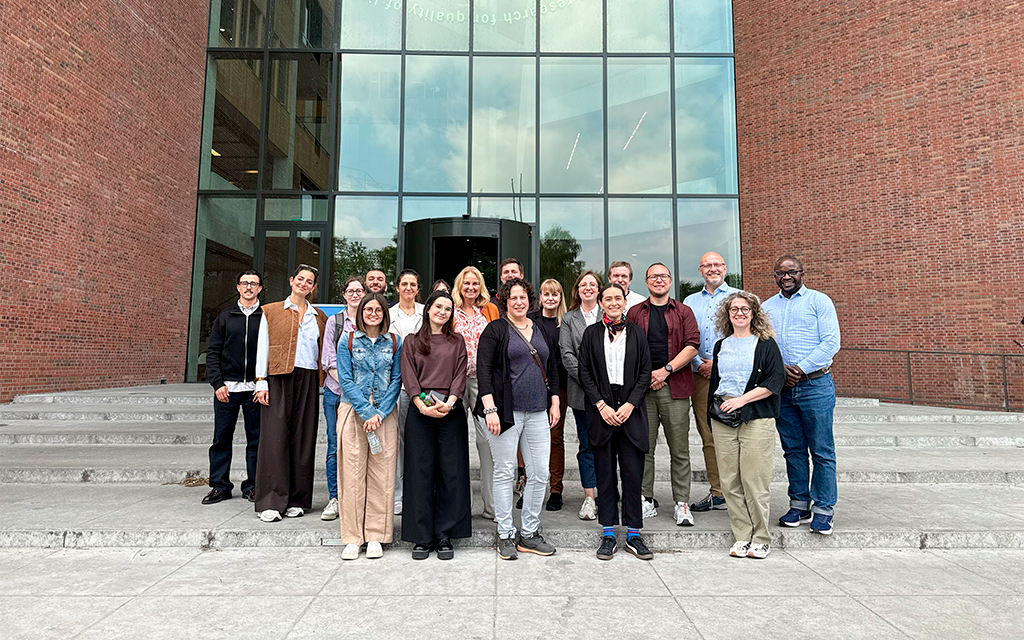
The conference was organised by Centexbel and held on 13 October 2026 in Ghent, Belgium. It brought together researchers and industry to look at where flame retardancy is heading. Pressure is growing to move away from halogenated and PFAS-based chemistry and to design materials that can be recycled at the end of their life. Bio-based alternatives fit squarely into that conversation.
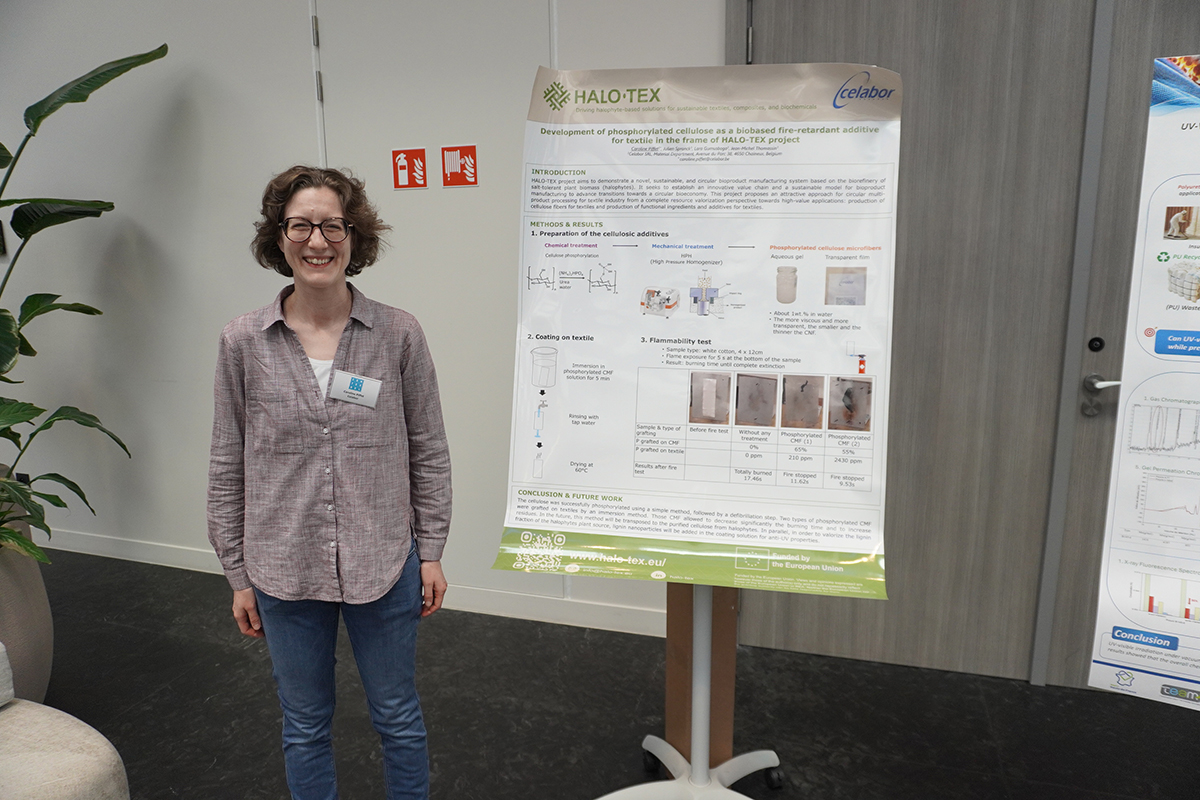
Caroline Piffet, from the Belgian research centre Celabor, presented the poster “Development of phosphorylated cellulose as biobased fire-retardant additive for textile in the frame of HALO-TEX project” on behalf of the project.
HALO-TEX works with halophytes, plants that grow in salty soils. The project’s idea is to process this biomass in a biorefinery so that nothing goes to waste. One part becomes cellulose fibres for new textiles. The rest is turned into ingredients and additives with added value.
Celabor leads the project’s work on textile additives, and the poster focused on one of them: a flame retardant made from halophyte cellulose.
Cellulose that resists fire
The work starts from cellulose that has already been extracted and purified from the halophytes by another team in the project. Celabor chemically modifies it by attaching phosphorus-based groups to the surface of the fibres. These groups give the material its flame-retardant effect. They also make the fibres easier to break down into very fine cellulose microfibres, which suit a coating better.
The poster describes getting the chemistry right as a balancing act. The team is testing different reaction temperatures, times and proportions, and uses several analytical techniques to measure how well the modification has worked.
More than one additive from the same plant
Cellulose is not the only plant component Celabor is working with in HALO-TEX. The team is also exploring lignin, the natural polymer that gives plants their rigidity and is often treated as a by-product, as a source of additives for textiles.
The approach shows what HALO-TEX means by circularity in practice: a single plant source can provide both the fibre and the functional finish, with bio-based chemistry as an alternative to conventional additives.
You can see the poster here.
Reference
Piffet, C., Spronck, J., Gumusboga, L., & Thomassin, J.-M. (2026). Development of phosphorylated cellulose as biobased fire-retardant additive for textile in the frame of HALO-TEX project [Graphic]. Zenodo. Flame Retardants and Fire Behaviour of Textiles and Plastics (FR conference 2026), Ghent.