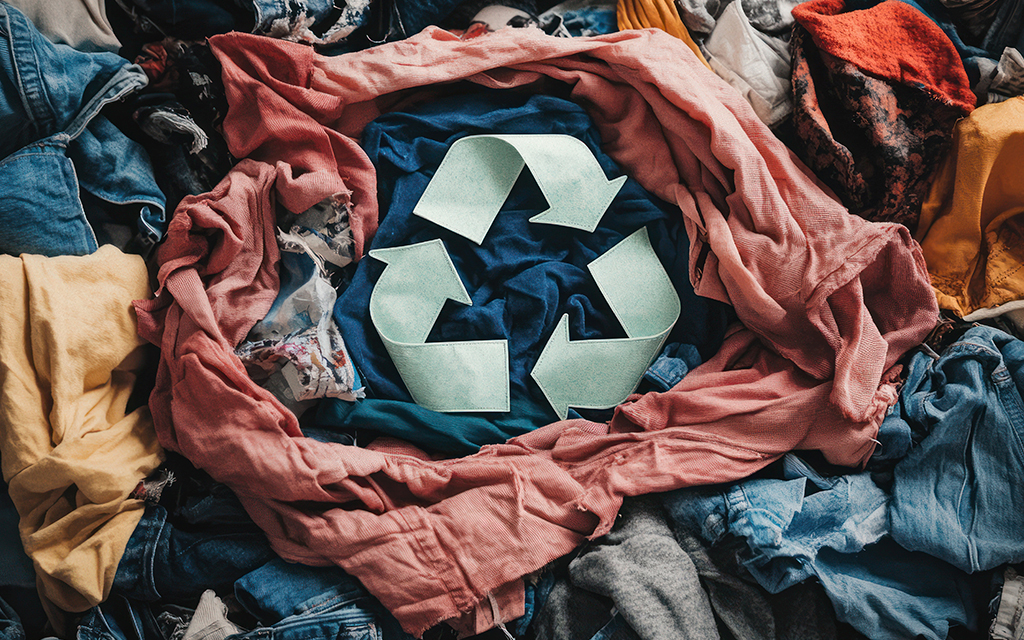
Every year, Europe discards millions of tonnes of clothing and textiles. Most of it never gets a second life. And the systems designed to change that are still, by most measures, not working at scale. In the face of this reality, the question is no longer whether the textile sector needs to change; it is whether the proposed solutions are bold enough.
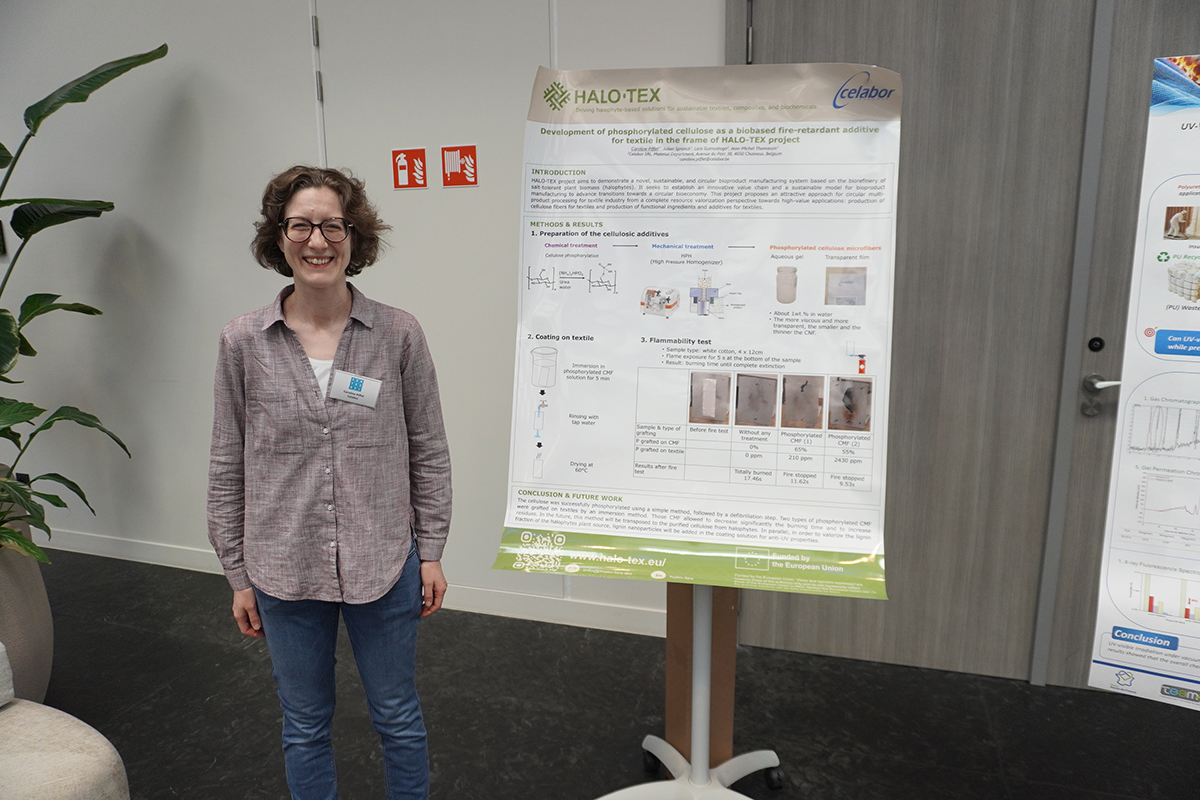
That is exactly where HALO-TEX enters the picture. Although policy and industry focus on collecting and recycling what already exists, HALO-TEX is asking a different question: what if the fibers themselves were part of the solution? The project explores halophyte plants growing on salt-affected, marginal land that no food crop would touch, as a source of sustainable textile fibers and biochemicals. No competition with agriculture. No pressure on freshwater. A raw material that fits, by design, into a circular model.
The European Environment Agency (EEA) leaves no room for doubt about the scale of the problem. According to its 2024 briefing, Management of used and waste textiles in Europe's circular economy:
"The EU generated an estimated 6.95 million tonnes of textile waste in 2020, around 16 kg per person. Of this, 4.4 kg per person were collected separately for reuse and recycling, and 11.6 kg per person ended up in mixed household waste."
That means more than 70% of all textile waste generated in the EU ends up undifferentiated in the general waste stream, and from there, largely in incinerators or landfills.
Equally striking is what happens before textiles even reach consumers. The same EEA report notes that "an estimated 4-9% of all textile products put on the market in Europe are destroyed before use, amounting to between 264,000 and 594,000 tonnes of textiles each year." These are products that never served any purpose, a structural waste built into the business model itself.
In response to this challenge, the EU's revised Waste Framework Directive, which, according to the EEA, "mandates that from 2025, EU Member States must establish separate collection systems for used textiles", acts as a meaningful step forward. But the current baseline reveals how much ground remains to be covered.
As the EEA reports: "The average capture rate for textile waste in Europe is only 12%, indicating that the rest ends up in mixed municipal waste and is consequently landfilled or incinerated."
The leading countries, Luxembourg and Belgium at 50%, the Netherlands at 37%, and Austria at 30%, show that higher collection rates are achievable. But they remain the exception. And collection alone is not sufficient: the EEA warns that "if sorting and recycling capacities are not scaled up in Europe, there is a risk that significant amounts of collected textile waste will continue to end up in incinerators or landfills or be exported to regions outside the EU."
The fate of exported textiles is particularly concerning. Germany, Poland, and Lithuania are identified as major exporters of used and waste textiles outside the EU, and as the EEA notes elsewhere, "the fate of used textiles exported from the EU is highly uncertain."
Recycling: An unfinished solution
What about recycling capacity? The EEA notes that there are 17 textile recycling companies in Europe, "which expect to recycle 1.25 to 1.3 million tonnes of fibres annually until 2025, 1 million tonnes through mechanical recycling and 250,000 tonnes through chemical recycling." However, the agency adds an important limitation: "Most of the recycled fibres are downcycled into e.g. rags or insulation materials."
Fiber-to-fiber recycling, the kind that might truly close the loop, remains largely at pilot scale. The infrastructure simply has not kept pace with the ambition.
There is also a greater structural barrier. As the EEA points out when discussing repair and reuse: "Establishing large-scale repair operations in European countries is a challenge because of commercial non-viability. This is primarily due to the combination of high labor costs and notably lower pricing for new products manufactured in, for example, Asia."
In other words, the circular economy for textiles is fighting against a market logic that currently rewards disposal over durability.
The urgency of transforming the textile sector is particularly evident when viewed in the context of the EU's wider environmental ambitions.The EEA's 2026 briefing, The environmental and climate benefits of a circular economy, presents a compelling picture of what a more circular economy across sectors could achieve.
According to the EEA, "a combination of just 17 circular economy interventions can potentially reduce the EU's impact on climate by 22% or almost 1 billion tonnes of CO₂e, on biodiversity by 19% and on air pollution by 25%."
Textiles are explicitly part of this calculation. The EEA identifies "increased repair and maintenance of textiles" as one of the five circular economy interventions with the greatest potential to reduce land-use-related biodiversity loss. The logic is clear: longer-lasting products mean less demand for raw materials, and less pressure on the land systems that sustain biodiversity.
The agency also stresses that ambition levels matter enormously: "Applying a high ambition level for the 17 modelled interventions achieves more than 80% higher environmental and climate benefits than a medium ambition level." Half-measures will not get Europe where it needs to go.
The policy framework is evolving. Extended Producer Responsibility (EPR) for textiles is being introduced across the EU, with France, Hungary, and the Netherlands already operating mandatory schemes. The European Commission has proposed harmonized EPR regulations with the aim, as the EEA describes it, of establishing "an economy focused on collecting, sorting, reusing and recycling textiles, while also ensuring that products are designed with circularity in mind."
But regulation and collection infrastructure address the end of the textile lifecycle. A genuinely circular system also requires rethinking the beginning: where fibers come from, what they are made of, and how they interact with natural systems.
This is the gap that HALO-TEX is designed to address.
Where HALO-TEX fits in
HALO-TEX is a research and innovation project exploring halophytes, salt-tolerant plants that grow on marginal, saline, or flood-prone land, as a source of sustainable textile fibers and biochemicals. These are not conventional crops. They do not compete with food production. They can grow on land unsuitable for agriculture, require minimal freshwater input, and, in some cases, even contribute to soil restoration.
This matters in a context where, as the EEA notes, the International Resource Panel estimates that "90% of land-based biodiversity loss can be attributed to the extraction and processing of natural resources."
Introducing a fiber source that avoids these pressures and does not require clearing land, diverting water, or applying intensive chemistry is not a marginal improvement. It is a structural shift in where the textile sector's raw materials come from and what they cost the planet.
At the same time, HALO-TEX is investigating the biochemical compounds that halophytes produce, compounds with possible applications across multiple value chains. This opens the possibility of a model in which nothing is wasted: the parts of the plant not used for fiber become feedstocks for other industries, creating genuinely integrated circular value.
Europe's textile waste problem will not be solved through collection and recycling alone. It needs coordinated action across the entire lifecycle of textiles: better design, longer use, effective collection, real recycling, and, crucially, better raw materials to begin with.
As the EEA makes clear, the possible benefits of a more circular economy are considerable and measurable. But achieving them requires, in the agency's own words, "high, far-reaching targets for circular economy policies to maximise the potential benefits."
HALO-TEX is one piece of that larger picture, focused on the upstream end, where innovation in feedstocks can reduce the pressure the textile industry places on land, water, and biodiversity. Projects like this do not replace the policy and infrastructure work underway. They make it more likely to succeed.
References:
- European Environment Agency (2024). Management of used and waste textiles in Europe's circular economy. EEA Briefing 03/2024.
- European Environment Agency (2026). The environmental and climate benefits of a circular economy. EEA Briefing 12/2026.